Eklablog Tous les blogs Top blogs Religions & Croyances
Suivre ce blog Administration + Créer mon blog
MENU

Ayn Rand - The Cult of Moral Grayness

Publié le par antoiniste

"The Cult of Moral Grayness"
by Ayn Rand
(published in THE OBJECTIVIST NEWSLETTER, June, 1964,
and included as chapter 9 in the book, THE VIRTUE OF SELFISHNESS):
-------

     One of the most eloquent symptoms of the moral bankruptcy of today's culture, is a certain fashionable attitude toward moral issues, best summarized as: "There are no blacks and whites; there are only grays."

     This is asserted in regard to persons, actions, principles of conduct, and morality in general.  "Black and white," in this context, means "good and evil."  (The reverse order used in that catch phrase is interesting psychologically.)

     In any respect one cares to examine, that notion is full of contradictions (foremost among them is the fallacy of "the stolen concept").  If there is no black and white, there can be no gray -- since gray is merely a mixture of the two.

     Before anyone can identify anything as "gray," one has to know what is black and what is white.  In the field of morality, this means that one must first identify what is good and what is evil.  And when a man has ascertained that one alternative is good and the other is evil, he has no justification for choosing a mixture.  There can be no justification for choosing any part of that which one knows to be evil.

-----

     If a moral code (such as altruism) is, in fact, impossible to practice, it is the code that must be condemned as "black," not its victims evaluated as "gray."  If a moral code prescribes irreconcilable contradictions -- so that by choosing the good in one respect, a man becomes evil in another -- it is the code that must be rejected as "black."  If a moral code is inapplicable to reality -- if it offers no guidance except a series of arbitrary, groundless, out-of-context injunctions and commandments, to be accepted on faith and practiced automatically, as blind dogma -- its practitioners cannot properly be classified as "white" or "black" or "gray": a moral code that forbids and paralyzes moral judgment is a contradiction in terms.

     If, in a complex moral issue, a man struggles to determine what is right and fails or makes an honest error, he cannot be regarded as "gray"; morally, he is "white."  Errors of knowledge are not breaches of morality; no proper moral code can demand infallibility or omniscience.

     But if, in order to escape the responsibility of moral judgment, a man closes his eyes and mind, if he evades the facts of the issue and struggles not to know, he cannot be regarded as "gray"; morally, he is as "black" as they come.

     Many forms of confusion, uncertainty and epistemological sloppiness help to obscure the contradictions and to disguise the actual meaning of the doctrine of moral grayness.

     Some people believe that it is merely a restatement of such bromides as "Nobody is perfect in this world" -- i.e., everybody is a mixture of good and evil, and, therefore, morally "gray."  Since the majority of those one meets are likely to fit that description, people accept it as some sort of natural fact, without further thought.  They forget that morality deals only with issues open to man's choice (i.e., to his free will) -- and, therefore, that no statistical generalizations are valid in this matter.

     If man is to be "gray" by nature, no moral concepts are applicable to him, including "grayness," and no such thing as morality is possible.  But if man has free will, then the fact that ten (or ten million) men made the wrong choice, does not necessitate that the eleventh one will make it; it necessitates nothing -- and proves nothing -- in regard to any given individual.

-----

     There are, of course, complex issues in which both sides are right in some respects and wrong in others -- and it is here that the "package deal" of pronouncing both sides "gray" is least permissible.  It is in such issues that the most rigorous precision of moral judgment is required to identify and evaluate the various aspects involved -- which can be done only by unscrambling the mixed elements of "black" and "white."

     The basic error in all these various confusions is the same: it consists of forgetting that morality deals only with issues open to man's choice -- which means: forgetting the difference betwen "unable" and "unwilling."  This permits people to translate the catch phrase "There are no blacks and whites" into: "Men are unable to be wholly good or wholly evil" -- which they accept in foggy resignation, without questioning the metaphysical contradictions it entails.

     But not many people would accept it, if that catch phrase were translated into the actual meaning it is intended to smuggle into their minds: "Men are unwilling to be wholly good or wholly evil."

     The first thing one would say to any advocate of such a proposition, is: "Speak for yourself, brother!"  And that, in effect, is what he is actually doing; consciously or subconsciously, intentionally or inadvertently, when a man declares: "There are no blacks and whites," he is making a psychological confession, and what he means is: "I am unwillling to be wholly good -- and please don't regard me as wholly evil!"

     Just as in epistemology, the cult of uncertainty is a revolt against reason -- so, in ethics, the cult of moral grayness is a revolt against moral values.  Both are a revolt against the absolutism of reality.

-----

     Observe, in politics, that the term extremism has become a synonym of "evil," regardless of the content of the issue (the evil is not what you are extreme about, but that you are "extreme" -- i.e., consistent).  Observe the phenomenon of the so-called neutralists in the United Nations: the "neutralists" are worse than merely neutral in the conflict between the United States and Soviet Russia; they are committed, on principle, to see no difference between the two sides, never to consider the merits of an issue, and always to seek a compromise, any compromise in any conflict ... .

-----

     Like a mixed economy, men of mixed premises may be called "gray"; but, in both cases, the mixture does not remain "gray" for long.  "Gray," in this context, is merely a prelude to "black."  There may be "gray" men, but there can be no "gray" moral principles.  Morality is a code of black and white.  When and if men attempt a compromise, it is obvious which side will necessarily lose and which will necessarily profit.

     Such are the reasons why -- when one is asked: "Surely you don't think in terms of black-and-white, do you?" -- the proper answer (in essence, if not in form) should be: "You're damn right I do!"


-- The entire article became chapter 9 in the book, THE VIRTUE OF SELFISHNESS by Ayn Rand, which is even more relevant today.

source : http://freedomkeys.com/ar-moralgrayness.htm

Voir les commentaires

What a wonderful world

Publié le par antoiniste

Ou comment une chanson qui chante la beauté du monde et des gens se tranforme en chanson indésirable."Nous nous égarons [...] en nous appuyant sur des termes de comparaison qui nous montrent le bien dans le mal et le mal dans le bien, puisque seule la réalité nous froisse."
Le Couronnement de l'OEuvre Révélée, Cause, développement & perfectionnement de l'être, p.XXII

"What a wonderfull world" de Louis Armstrong après les attentats du 11 septembre qui ont été interdites d'antennes aux USA pendant un bon mois. (cf. wikipedia)

On peut écouter la merveilleuse version d'Israel IZ Kamakawiwo'ole :


Somewhere, over the rainbow, way up high,
And the dreams that you dreamed of, Once in a lullaby.
Oh, somewhere over the rainbow, blue birds fly,
And the dreams that you dreamed of, Dreams really do come true.

Someday, I'll wish upon a star,
Wake up where the clouds are far behind me.
Where trouble melts like lemon drops,
High above the chimney top,
That's where you'll find me.

Oh, somewhere, over the rainbow, bluebirds fly,
And the dreams that you dare to. Oh why, oh why can't I..?

Well, I see trees of green and red roses too,
I'll watch them bloom for me and you.
And I think to myself: What a wonderful world..!

Well, I see skies of blue and I see clouds of white,
And the brightness of day.
I like the dark and I think to myself:
What a wonderful world..!

The colors of the rainbow, so pretty in the sky,
Are also on the faces of people passing by.
I see friends shaking hands, saying, "How do you do?"
They're really saying, " I...I love you!"

I hear babies cry, and I watch them grow,
They'll learn much more than we'll know.
And I think to myself: What a wonderful world..!

Someday, I'll wish upon a star,
Wake up where the clouds are far behind me.
Where trouble melts like lemon drops,
High above the chimney top,
That's where you'll find me.

Oh, somewhere, over the rainbow, way up high.
And the dreams that you dare to, Oh why, oh why can't I..?


music by Harold Arlen and lyrics by Yip Harburg

Voir les commentaires

La Dame à la licorne - A mon seul désir

Publié le par antoiniste

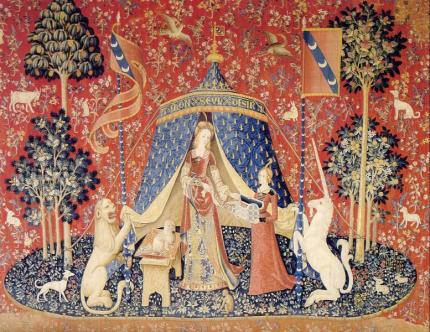
illustration : La Dame à la Licorne - A mon seul désir (source : stanford.edu)

La Dame à la licorne est une série de six tapisseries datant de la fin du XVe siècle, que l'on peut voir au musée national du Moyen Âge (Thermes et Hôtel de Cluny, à Paris). Inspirées d'une légende allemande du XVe siècle, les tapisseries dites de « La Dame à la licorne » furent tissées dans les Flandres entre 1484 et 1500.
source : http://fr.wikipedia.org/wiki/La_Dame_à_la_licorne

La signification de la dernière tapisserie reste mystérieuse. Plusieurs interprétations ont ainsi été faites. L'une d'entre elles est particulièrement intéressante. "A Mon Seul Désir", tel est le nom attribué à cette merveilleuse tapisserie. Sur cette pièce, la Dame remet dans le coffre à bijoux le collier qu'elle portait sur les autres tapisseries. La signification la plus souvent retenue est celle du refus de la tentation, et de la renonciation aux cinq sens précédemment énoncés.
source : http://www.licornedecluny.com/docdamlicorn.htm

Selon une interprétation contraire (de Marie-Elisabeth Bruel, docteur ès Lettres, Attachée de Conservation du Patrimoine, responsable de l’Inventaire au Conseil Général de l’Allier (Auvergne)), les six tentures traditionnellement identifiées comme les cinq sens et "A mon seul désir" représenteraient six des Vertus allégoriques courtoises du Roman de la Rose de Guillaume de Lorris, soit respectivement : Oiseuse (la Vue), Richesse (le Toucher), Franchise (le Goût), Liesse (l'Ouïe), Beauté (l'Odorat), Largesse (A mon seul désir).
source : http://fr.wikipedia.org/wiki/La_Dame_%C3%A0_la_licorne#Description

Voir les commentaires

Auguste Villers de l'Isle-Adam - Autre lieu, autre usage

Publié le par antoiniste

    Songe que, né en d'autres pays, tu penserais d'après d'autres usages, et qu'il n'est, pour l'Homme, d'autre vérité que celle qu'il accepte de croire entre toutes les autres, - aussi douteuses que celle qu'il choisit: choisis donc celle qui te rend un dieu.

Auguste Villiers de L'Isle-Adam, L'Eve Future
Flammarion, p.381, Livre VI, Chapitre VIII

Voir les commentaires

J.H.Rosny, La mort de la terre - Prophétie ?

Publié le par antoiniste

    Depuis cinq cents siècles, les hommes n'occupaient plus, sur la planète, que des îlots dérisoires. L'ombre de la déchéance avait de loin précédé les catastrophes. A des époques fort anciennes, aux premiers siècles de l'ère radio-active, on signale déjà la décroissance des eaux : maints savants prédisent que l'Humanité périra par la sécheresse. Mais quel effet ces prédictions pouvaient-elles produire sur des peuples qui voyaient des glaciers couvrir leurs montagnes, des rivières sans nombre arroser leurs sites, d'immenses mers battre leurs continents ? Pourtant, l'eau décroissait lentement, sûrement, absorbée par la terre et volatilisée dans le firmament (1). Puis, vinrent les fortes catastrophes. On vit d'extraordinaires remaniements du sol ; parfois, des tremblements de terre, en un seul jour, détruisaient dix ou vingt villes et des centaines de villages : de nouvelles chaînes de montagnes se formèrent, deux fois plus hautes que les antiques massifs des Alpes, des Andes ou de l'Himalaya ; l'eau tarissait de siècle en siècle. Ces énormes phénomènes s'aggravèrent encore. A la surface du soleil, des métamorphoses se décelaient qui, d'après des lois mal élucidées, retentirent sur notre pauvre globe. Il y eut un lamentable enchaînement de catastrophes : d'une part, elles haussèrent les hautes montagnes jusqu'à vingt-cinq et trente mille mètres ; d'autre part, elles firent disparaître d'immenses quantités d'eau.

(1) Dans les hautes régions atmosphériques, la vapeur d'eau fut de tout temps décomposée, par les rayons ultra-violets, en oxygène et en hydrogène : l'hydrogène s'échappait dans l'étendue interstellaire.

J.H.Rosny, La mort de la terre, p.19 (1912)
source : archive.org

Voir les commentaires

Le monde a t-il été créé en 7 jours ?

Publié le par antoiniste

    A voir sur Dailymotion.

Voir les commentaires

Der Bethlehem-Trip - Schwanger durch die Wüste - Funkhaus Europa

Publié le par antoiniste

Folge 10: Die Namensuche
Auf ihrem Trip durch die Wüste von Nazareth nach Bethlehem haben Mary und Joseph ausreichend Zeit, sich Namen für das noch ungeborene Kind zu überlegen. Da sie nicht wissen, ob es ein Mädchen oder ein Junge wird, schmökern sie in dem großen Buch der Vornamen nach beidem.

    * Autor/-in:Uli Höhmann
    * Länge:1:14 Minuten
    * Datum:Freitag, 11. Dezember 2009
    * Sendereihe:Café Mondial | Funkhaus Europa

source : Schwanger durch die Wüste - Funkhaus Europa - Radio Bremen

Voir les commentaires

Voltaire - La résurrection

Publié le par antoiniste

    "Je vois bien, dit-elle à l’oiseau, que vous êtes le phénix dont on m’avait tant parlé. Je suis prête à mourir d’étonnement et de joie. Je ne croyais point à la résurrection ; mais mon bonheur m’en a convaincue. — La résurrection, madame, lui dit le phénix, est la chose du monde la plus simple. Il n’est pas plus surprenant de naître deux fois qu’une. Tout est résurrection dans ce monde ; les chenilles ressuscitent en papillons ; un noyau mis en terre ressuscite en arbre ; tous les animaux ensevelis dans la terre ressuscitent en herbes, en plantes, et nourrissent d’autres animaux dont ils font bientôt une partie de la substance : toutes les particules qui composaient les corps sont changées en différents êtres. Il est vrai que je suis le seul à qui le puissant Orosmade ait fait la grâce de ressusciter dans sa propre nature. "

Voltaire, La Princesse de Babylone
Chapitre  IV
source : Wikisource

Voir les commentaires

Auguste Villers de l'Isle-Adam - Un pressentiment, un vertige, - ou dans un désir

Publié le par antoiniste

    - Oh! reprit Hadaly, c'était très raisonnable! Ainsi, tu oubliais, cependant, que la plus certaine de toutes les réalités, - celle, tu le sais bien, en qui nous sommes perdus et dont l'inévitable substance, eu nous, n'est qu'idéale - (je parle de l'Infini,) - n'est pas seulement que raisonnable. Nous en avons une lueur si faible, au contraire, que nulle raison, bien que constatant cette inconditionnelle nécessité, ne saurait en imaginer l'idée autrement que par un pressentiment, un vertige, - ou dans un désir.

Auguste Villiers de L'Isle-Adam, L'Eve Future
Flammarion, p.375, Livre VI, Chapitre VI

Voir les commentaires

Auguste Villers de l'Isle-Adam - Un pressentiment, un vertige, - ou dans un désir

Publié le par antoiniste

    - Oh! reprit Hadaly, c'était très raisonnable! Ainsi, tu oubliais, cependant, que la plus certaine de toutes les réalités, - celle, tu le sais bien, en qui nous sommes perdus et dont l'inévitable substance, eu nous, n'est qu'idéale - (je parle de l'Infini,) - n'est pas seulement que raisonnable. Nous en avons une lueur si faible, au contraire, que nulle raison, bien que constatant cette inconditionnelle nécessité, ne saurait en imaginer l'idée autrement que par un pressentiment, un vertige, - ou dans un désir.

Auguste Villiers de L'Isle-Adam, L'Eve Future
Flammarion, p.375, Livre VI, Chapitre VI

Voir les commentaires